Nodal Analysis
Definition: Nodal Analysis is a method used to evaluate a complete producing system by isolating a single point (the Node) and ensuring the pressure and flow rate are consistent across that point. In petroleum production, the most common node is the Bottom-hole, where the Inflow (IPR) meets the Outflow (VLP).
The Node Concept
For any given node, two conditions must be met:
Flow into the node equals flow out of the node.
Only one pressure can exist at the node at a given flow rate.
The Node Equations:
Inflow (Supply): \(p_{node} = p_r - \Delta p_{reservoir}\)
Outflow (Demand): \(p_{node} = p_{surf} + \Delta p_{tubing} + \Delta p_{choke}\)
Determining the Operating Point
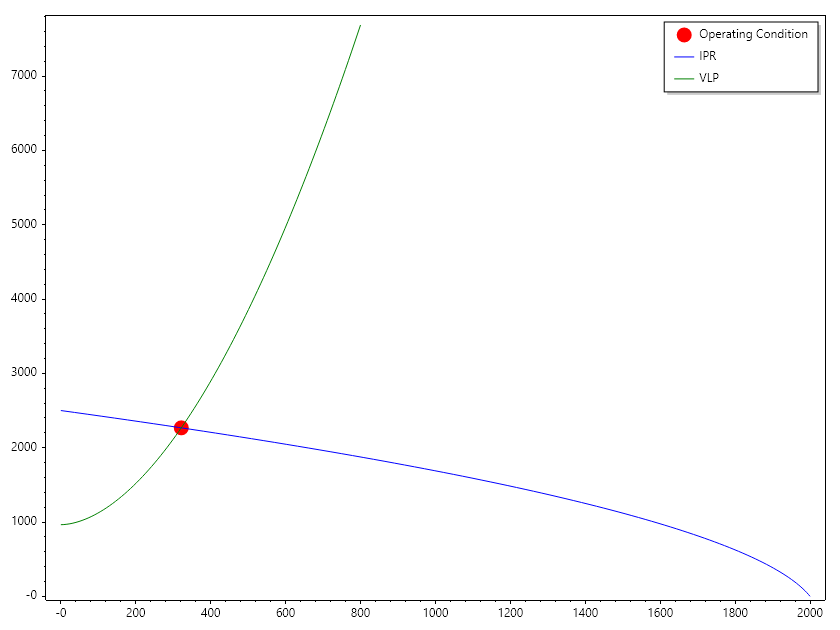
The intersection of the IPR curve and the VLP curve represents the Operating Point. This is the only rate (:math:q_{actual}) at which the well will naturally flow for a given set of conditions.
Numerical Example:
Consider a well with:
Reservoir Pressure (\(p_r\)) = 3500 psi
Productivity Index (\(J\)) = 1.2 STB/day/psi
Surface Pressure (\(p_{surf}\)) = 250 psi
VLP is simplified as: \(p_{wf} = p_{surf} + 0.00002 q^{1.8}; + \rho/144\)
To find the operating point, we solve for \(q\) where \(p_{wf, IPR} = p_{wf, VLP}\).
//IPR Input
double q_max = 2000; // STB/day
double p_r = 2500; // psi
double p_wf = 1000; // psi

//IPR
double qfun(double pwf) => q_max * (1 - 0.2 * (pwf / p_r) - 0.8 * Pow(pwf / p_r, 2));
ColVec P_ipr = Linspace(0, p_r);
ColVec Q_ipr = Arrayfun(qfun, P_ipr);

// VLP Inputs
double p_surf = 200; // psi (Wellhead Pressure)
double depth = 2000; // ft


// VLP
double pressureGradient(double z, double p, double q)
{
    double density = 55.0; // lb/ft3 (Oil)
    double friction_grad = 0.00002 * Pow(q, 1.8); // Simplified friction term
    double hydro_grad = density / 144.0; // psi/ft
    return hydro_grad + friction_grad;
}
double pfun(double q_g)
{
    var (Z, P) = Ode45((z, p) => pressureGradient(z, p, q_g), p_surf, [0, depth]);
    double p_wf = P[^1]; // extract the pressure at the bottom
    return p_wf;
}

ColVec Q_vlp = Linspace(0, 800);
ColVec P_vlp = Arrayfun(pfun, Q_vlp);

(double operating_q, double operating_p) = Intersection(Q_vlp, P_vlp, Q_ipr, P_ipr);
// Assuming a simple bisection or search between 0 and AOF
Scatter(operating_q, operating_p, "for", 15); HoldOn();
Plot(Q_ipr, P_ipr, "b");
Plot(Q_vlp, P_vlp, "g"); HoldOff();
Legend(["Operating Condition", "IPR", "VLP"]);
SaveAs("Nodal_Analysis.png");
Sensitivity Analysis
Nodal analysis is most powerful when performing “What-If” scenarios. By shifting the curves, engineers can predict the impact of changes:
Stimulation Economics: A Nodal Analysis Case Study
Problem Statement: An oil company is evaluating two competing stimulation proposals to improve the productivity of a damaged well. The well is currently performing poorly due to a high skin factor (\(s = +5\)). The goal is to determine which intervention provides the best return on investment by calculating the production gain per million USD spent.
Reservoir and Well Data
Parameter |
Value |
Unit |
|---|---|---|
Reservoir Pressure(\(p_r\)) |
2800 |
psia |
Bubble Point(\(p_b\)) |
3000 |
psia |
Current Skin Factor(\(s_{ current}\)) |
+5 |
dimensionless |
Max Flow Rate(Ideal \(q_{ max}\)) |
2000 |
STB/day |
Reservoir Radius / Wellbore Radius(\(r_e/r_w\)) |
1000 |
dimensionless |
Well Depth |
4000 |
ft |
Oil Density |
55.0 |
\(lb/ft^3\) |
Surface Pressure(\(p_{ surf}\)) |
200 |
psia |
Stimulation Offers:
*Company A(Hydraulic Frac):**Reduces skin to :math:`-3`. Cost: **$10M. * Company B(Acid Wash):**Reduces skin to :math:`+1`. Cost: **$5M.
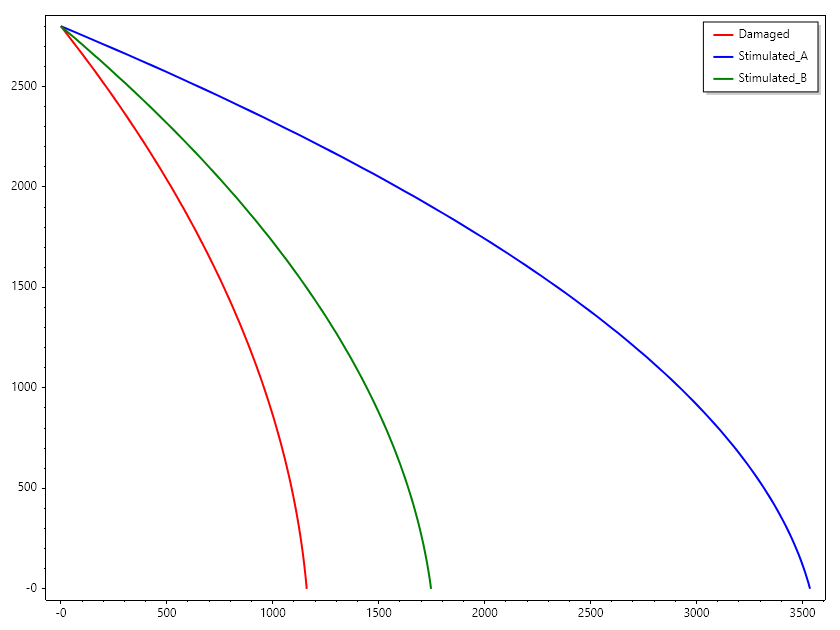
Solution - 1. Compute IPR and Flow Efficiency Since the reservoir pressure(\(p_r = 2800\)) is below the bubble point(\(p_b = 3000\)), the well follows Vogel’s non-linear behavior. We first determine the Flow Efficiency (\(FE\)) for each skin scenario. The relationship between skin and productivity adjustment is: \(J_{ ratio} = \frac{\ln(r_e/r_w)}{\ln(r_e/r_w) + s}\)
//IPR Input
double q_max = 2000; // STB/day
double p_r = 2800; // psi

//IPR
double qfun(double pwf) => q_max * (1 - 0.2 * (pwf / p_r) - 0.8 * Pow(pwf / p_r, 2));
ColVec P_ipr = Linspace(0, p_r);
ColVec Q_ipr = Arrayfun(qfun, P_ipr);

// Adjusting for Damage and Stimulation
double r_e_r_w = 1000;
double FE_Damaged = Log(r_e_r_w)/(Log(r_e_r_w) + 5);
double FE_Stimulation_A = Log(r_e_r_w)/(Log(r_e_r_w) + -3);
double FE_Stimulation_B = Log(r_e_r_w)/(Log(r_e_r_w) + 1);
ColVec Q_ipr_Damaged = Q_ipr * FE_Damaged;
ColVec Q_ipr_Stimulated_A = Q_ipr * FE_Stimulation_A;
ColVec Q_ipr_Stimulated_B = Q_ipr * FE_Stimulation_B;

Plot(Q_ipr_Damaged, P_ipr, "r", 2); HoldOn();
Plot(Q_ipr_Stimulated_A, P_ipr, "b", 2);
Plot(Q_ipr_Stimulated_B, P_ipr, "g", 2); HoldOff();
Legend(["Damaged", "Stimulated_A", "Stimulated_B"]);
SaveAs("IPR_Stimulation_Economics_Case_Study.png");
Compute the VLP
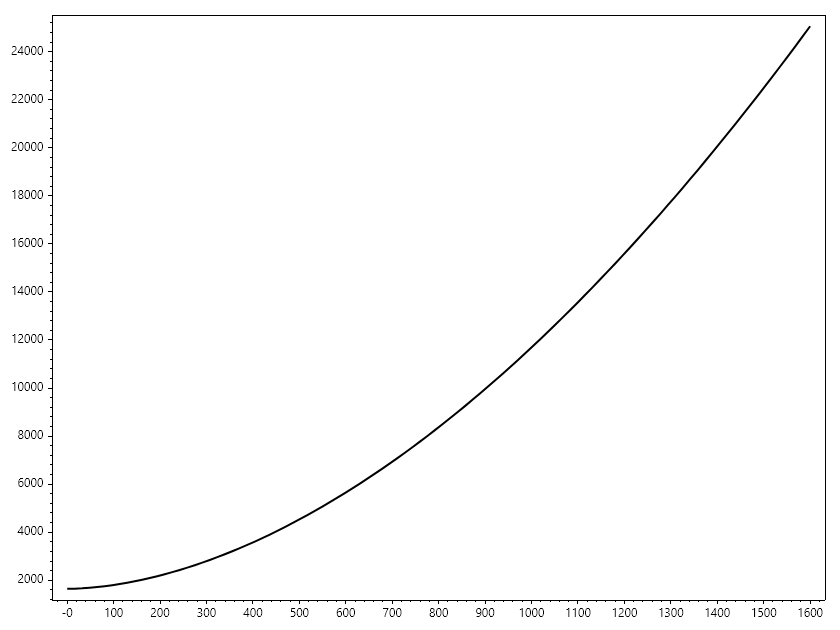
The Vertical Lift Performance is calculated by integrating the hydrostatic and frictional pressure drops from the surface to the bottom-hole.
// VLP Inputs
double p_surf = 200; // psi (Wellhead Pressure)
double depth = 4000; // ft


// VLP
double pressureGradient(double z, double p, double q)
{
    double density = 52.0; // lb/ft3 (Oil)
    double friction_grad = 1e-5 * Pow(q, 1.8); // Simplified friction term
    double hydro_grad = density / 144.0; // psi/ft
    return hydro_grad + friction_grad;
}
double pfun(double q_o)
{
    var (Z, P) = Ode45((z, p) => pressureGradient(z, p, q_o), p_surf, [0, depth]);
    double p_wf = P[^1]; // extract the pressure at the bottom
    return p_wf;
}

ColVec Q_vlp = Linspace(0, 1600);
ColVec P_vlp = Arrayfun(pfun, Q_vlp);

Plot(Q_vlp, P_vlp, "k", 2);
SaveAs("VLP_Stimulation_Economics_Case_Study.png");
Nodal Analysis and Operating Points
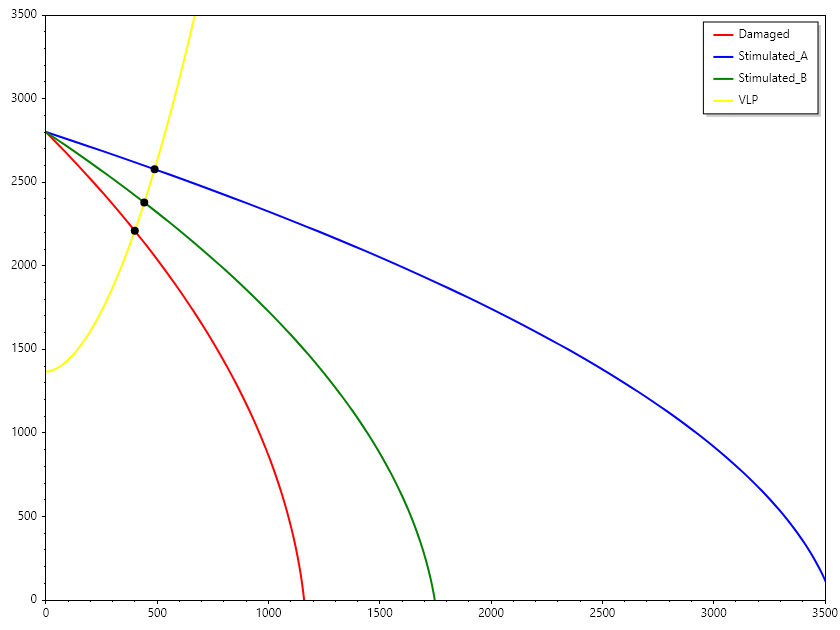
We find the intersection where: math:p_{ wf, IPR} = p_{ wf, VLP} for each case using ** SepalSolver**.
//IPR Input
double q_max = 2000; // STB/day
double p_r = 2800; // psi

//IPR
double qfun(double pwf) => q_max * (1 - 0.2 * (pwf / p_r) - 0.8 * Pow(pwf / p_r, 2));
ColVec P_ipr = Linspace(0, p_r);
ColVec Q_ipr = Arrayfun(qfun, P_ipr);

// Adjusting for Damage and Stimulation
double r_e_r_w = 1000;
double FE_Damaged = Log(r_e_r_w)/(Log(r_e_r_w) + 5);
double FE_Stimulation_A = Log(r_e_r_w)/(Log(r_e_r_w) + -3);
double FE_Stimulation_B = Log(r_e_r_w)/(Log(r_e_r_w) + 1);
ColVec Q_ipr_Damaged = Q_ipr * FE_Damaged;
ColVec Q_ipr_Stimulated_A = Q_ipr * FE_Stimulation_A;
ColVec Q_ipr_Stimulated_B = Q_ipr * FE_Stimulation_B;


// VLP Inputs
double p_surf = 200; // psi (Wellhead Pressure)
double depth = 3500; // ft


// VLP
double pressureGradient(double z, double p, double q)
{
    double density = 48.0; // lb/ft3 (Oil)
    double friction_grad = 5e-6 * Pow(q, 1.8); // Simplified friction term
    double hydro_grad = density / 144.0; // psi/ft
    return hydro_grad + friction_grad;
}
double pfun(double q_o)
{
    var (Z, P) = Ode45((z, p) => pressureGradient(z, p, q_o), p_surf, [0, depth]);
    double p_wf = P[^1]; // extract the pressure at the bottom
    return p_wf;
}

ColVec Q_vlp = Linspace(0, 1600);
ColVec P_vlp = Arrayfun(pfun, Q_vlp);


var (current_q, current_p) = Intersection(Q_ipr_Damaged, P_ipr, Q_vlp, P_vlp);
var (stimulatedA_q, stimulatedA_p) = Intersection(Q_ipr_Stimulated_A, P_ipr, Q_vlp, P_vlp);
var (stimulatedB_q, stimulatedB_p) = Intersection(Q_ipr_Stimulated_B, P_ipr, Q_vlp, P_vlp);

Plot(Q_ipr_Damaged, P_ipr, "r", 2); HoldOn();
Plot(Q_ipr_Stimulated_A, P_ipr, "b", 2);
Plot(Q_ipr_Stimulated_B, P_ipr, "g", 2);
Plot(Q_vlp, P_vlp, "y", 2);
Scatter([current_q, stimulatedA_q, stimulatedB_q],
    [current_p, stimulatedA_p, stimulatedB_p], "fok"); HoldOff();
Axis([0, 3500, 0, 3500]);
Legend(["Damaged", "Stimulated_A", "Stimulated_B", "VLP"]);
SaveAs("Nodal_Analysis_Stimulation_Economics_Case_Study.png");
Production Improvement and Economics
//IPR Input
double q_max = 2000; // STB/day
double p_r = 2800; // psi

//IPR
double qfun(double pwf) => q_max * (1 - 0.2 * (pwf / p_r) - 0.8 * Pow(pwf / p_r, 2));
ColVec P_ipr = Linspace(0, p_r);
ColVec Q_ipr = Arrayfun(qfun, P_ipr);

// Adjusting for Damage and Stimulation
double r_e_r_w = 1000;
double FE_Damaged = Log(r_e_r_w)/(Log(r_e_r_w) + 5);
double FE_Stimulation_A = Log(r_e_r_w)/(Log(r_e_r_w) + -3);
double FE_Stimulation_B = Log(r_e_r_w)/(Log(r_e_r_w) + 1);
ColVec Q_ipr_Damaged = Q_ipr * FE_Damaged;
ColVec Q_ipr_Stimulated_A = Q_ipr * FE_Stimulation_A;
ColVec Q_ipr_Stimulated_B = Q_ipr * FE_Stimulation_B;


// VLP Inputs
double p_surf = 200; // psi (Wellhead Pressure)
double depth = 4000; // ft


// VLP
double pressureGradient(double z, double p, double q)
{
    double density = 52.0; // lb/ft3 (Oil)
    double friction_grad = 1e-5 * Pow(q, 1.8); // Simplified friction term
    double hydro_grad = density / 144.0; // psi/ft
    return hydro_grad + friction_grad;
}
double pfun(double q_o)
{
    var (Z, P) = Ode45((z, p) => pressureGradient(z, p, q_o), p_surf, [0, depth]);
    double p_wf = P[^1]; // extract the pressure at the bottom
    return p_wf;
}

ColVec Q_vlp = Linspace(0, 1600);
ColVec P_vlp = Arrayfun(pfun, Q_vlp);

var (current_q, current_p) = Intersection(Q_ipr_Damaged, P_ipr, Q_vlp, P_vlp);
var (stimulatedA_q, stimulatedA_p) = Intersection(Q_ipr_Stimulated_A, P_ipr, Q_vlp, P_vlp);
var (stimulatedB_q, stimulatedB_p) = Intersection(Q_ipr_Stimulated_B, P_ipr, Q_vlp, P_vlp);

double BarrelPerDollar_A = (stimulatedA_q - current_q)/10;
double BarrelPerDollar_B = (stimulatedB_q - current_q)/5;

Console.WriteLine($"Barrel Per Dollar for Quote A: {BarrelPerDollar_A}");
Console.WriteLine($"Barrel Per Dollar for Quote B: {BarrelPerDollar_B}");
Ouput
Barrel Per Dollar for Quote A: 3.5733706107198175
Barrel Per Dollar for Quote B: 3.4741949196266146