Decline Curve Analysis
Definition: Decline Curve Analysis involves fitting a mathematical function to historical production rate data over time. The three standard models defined by Arps are Exponential, Hyperbolic, and Harmonic decline.
The General Equation
All three decline types are derived from the general equation:
Where:
\(q(t)\) = production rate at time \(t\)
\(q_i\) = initial production rate
\(D_i\) = initial nominal decline rate (1/time)
\(b\) = decline exponent (0 for exponential, 1 for harmonic)
Exponential Decline (\(b = 0\))
Used when the decline rate is constant. This is common in highly undersaturated oil reservoirs or wells with constant pressure boundaries.
Numerical Example:
Given:
\(q_i = 1000 \, \text{STB/day}\)
\(D = 0.05 \, \text{per month}\)
Find rate after 12 months:
double qi = 1000; // STB/day
double D = 0.05; // per month
double t = 12; // months
double q_t = qi * Exp(-D * t);
Console.WriteLine($"Rate after 12 months = {q_t:F2} STB/day");
Ouput
Rate after 12 months = 548.81 STB/day
Linearization for Exponential Decline
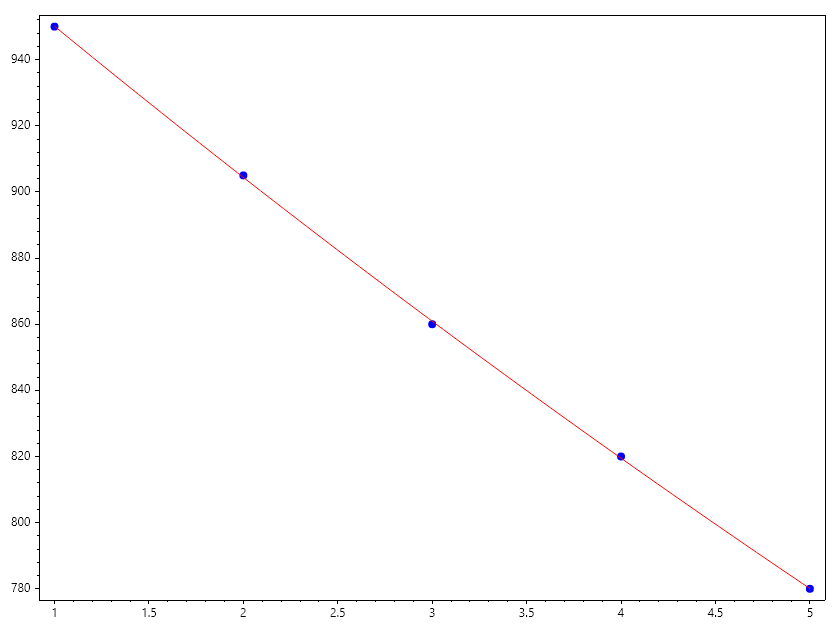
The exponential equation \(q = q_i e^{-Dt}\) can be linearized by taking the natural logarithm of both sides:
By plotting \(\ln(q)\) vs. \(t\), the slope is \(-D\) and the intercept is \(\ln(q_i)\).
Practical Example:
// Data: t (months), q (STB/day)
double[] t = [1, 2, 3, 4, 5];
double[] q = [950, 905, 860, 820, 780];

double[] Lnq = [..q.Select(Log)];

var p = Polyfit(t, Lnq, 1);


double D = -p[0];
double q_i = Exp(p[1]);
Console.WriteLine($"D = {D} per month");
Console.WriteLine($"q_i = {q_i} STB/day");

double[] T = Linspace(t[0], t[^1]);
double[] Q = [.. T.Select(t => q_i * Exp(-D*t))];

Scatter(t, q, "fob"); HoldOn();
Plot(T, Q, "r"); HoldOff();
SaveAs("Exponential_Fit.png");
Ouput
D = 0.049296673326352236 per month
q_i = 998.1220221050729 STB/day
Linearization for Harmonic Decline (\(b=1\))
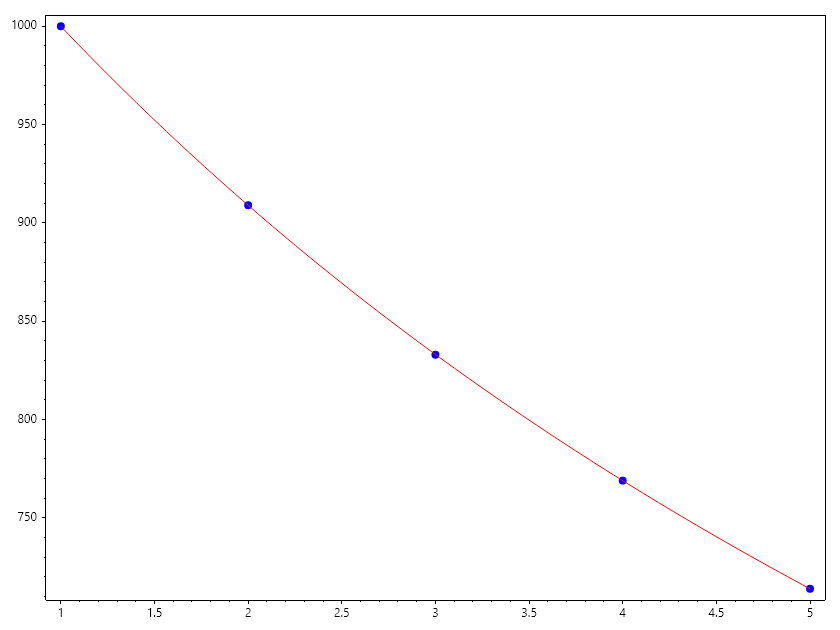
The harmonic equation \(q = q_i / (1 + D_i t)\) is linearized by taking the reciprocal of the rate:
By plotting \(1/q\) vs. \(t\), the slope is \(D_i/q_i\) and the intercept is \(1/q_i\).
Practical Example:
double[] t = [1, 2, 3, 4, 5];
double[] q = [1000, 909, 833, 769, 714];


double[] iq = [.. q.Select(q=>1/q)];

var p = Polyfit(t, iq, 1);

double D = p[0]/p[1];
double q_i = 1/p[1];
Console.WriteLine($"D = {D} per month");
Console.WriteLine($"q_i = {q_i} STB/day");

double[] T = Linspace(t[0], t[^1]);
double[] Q = [.. T.Select(t => q_i /(1 + D*t))];

Scatter(t, q, "fob"); HoldOn();
Plot(T, Q, "r"); HoldOff();
SaveAs("Harmonic_Fit.png");
Ouput
D = 0.11128058359645096 per month
q_i = 1111.2494708361232 STB/day
Hyperbolic Decline (\(0 < b < 1\))
The most common decline type. The decline rate itself decreases over time.
Numerical Example:
Given:
\(q_i = 1500 \, \text{Mscf/day}\)
\(D_i = 0.10 \, \text{per month}\)
\(b = 0.5\)
double qi = 1500;
double Di = 0.10;
double b = 0.5;
double t = 12;
double q_t = qi / Pow(1 + b * Di * t, 1 / b);
Console.WriteLine($"Hyperbolic Rate = {q_t:F2} Mscf/day");
Ouput
Hyperbolic Rate = 585.94 Mscf/day
Linearization for Hyperbolic Decline
Hyperbolic decline (\(0 < b < 1\)) cannot be fully linearized with simple variables because of the \(b\) exponent. Instead, we linearize the Loss Ratio (\(1/D\)), defined as \(a = q / (dq/dt)\):
To solve this, we compute the derivative of production over time, plot the loss ratio vs. \(t\), and find \(b\) (slope) and \(1/D_i\) (intercept).
Practical Example:
// Loss Ratio (a) calculated from historical data
double[] t = { 1, 2, 3, 4, 5 };
double[] loss_ratio = { 10.5, 11.0, 11.5, 12.0, 12.5 };
Cumulative Production and EUR
To calculate the Estimated Ultimate Recovery (EUR), we integrate the rate over time until a limit rate (\(q_{limit}\)) is reached.
For Exponential Decline:
double qi = 1000;
double q_limit = 50; // Economic limit
double D = 0.05;
double EUR = (qi - q_limit) / D;
Console.WriteLine($"EUR (Exponential) = {EUR:F2} STB");
Ouput
EUR (Exponential) = 19000.00 STB
Computing the Exponential Model Decline Rate
Using the given data
double[] t = [0, 10, 20, 30, 40, 50, 60, 70, 80, 90];
double[] qt = [double.NaN, 990.05, 980.20, 970.45, 960.78, 951.23, 941.76, 932.39, 923.12, 913.93];
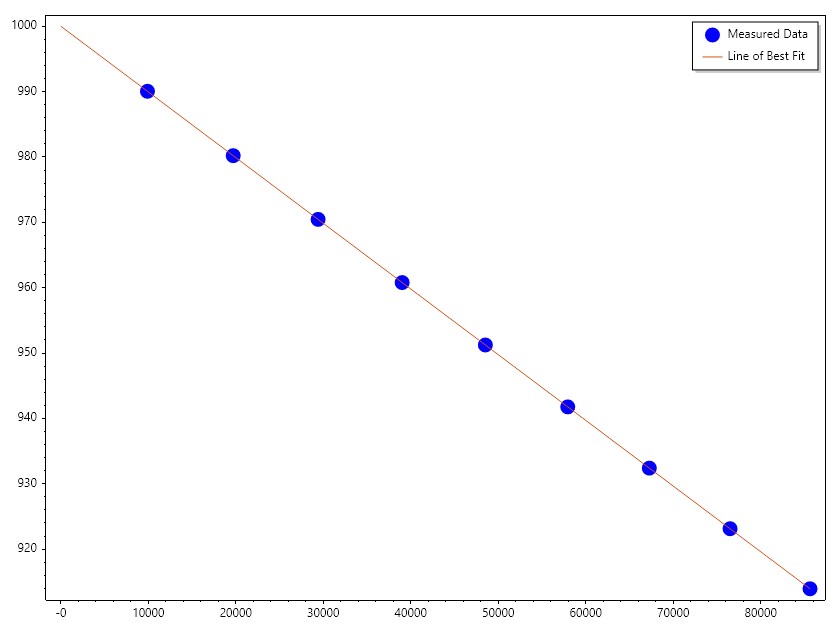
Solution - 1. Compute the commulative production Np - 2. Plot qt versus Np and measure the slope and intercept - 3. intercept is the \(q_i\) and slope is the \(D\)
double[] t = [0, 10, 20, 30, 40, 50, 60, 70, 80, 90];
double[] qt = [double.NaN, 990.05, 980.20, 970.45, 960.78, 951.23, 941.76, 932.39, 923.12, 913.93];
// Compute Cumulative
double[] Np = Zeros(t.Length);
for (int i = 1; i < t.Length; i++)
    Np[i] = Np[i-1] + qt[i]*(t[i] - t[i-1]);
// Compute Slope and Intercept
double[] coeffs = Polyfit(Np[1..], qt[1..], 1);

// Plot
Scatter(Np[1..], qt[1..], "fob", 15); HoldOn();
Plot(Np, [.. Np.Select(np => Polyval(coeffs, np))]); HoldOff();
Legend(["Measured Data", "Line of Best Fit"]);
SaveAs("Decline_Curve_Fitting.png");

// Print Result
Console.WriteLine($"D = {coeffs[0]}");
Console.WriteLine($"q_i = {coeffs[1]}");
Ouput
D = -0.0010050369357366175
q_i = 999.9999607852839
Data with Shutdown
Given this production history with shutdown
double[] qt = [990, 0, 980, 970, 0, 961, 951, 942, 0, 0, 932, 923, 914, 905];
double[] t = [10, 20, 30, 40, 50, 60, 70, 80, 90, 100, 110, 120, 130, 140];


double[] Np = Zeros(t.Length);
for (int i = 1; i < t.Length; i++)
    Np[i] = Np[i-1] + qt[i]*(t[i] - t[i-1]);

//filter
Np = [.. Np.Where((np, i) => qt[i] > 0)];
qt = [.. qt.Where((q, i) => qt[i] > 0)];
t = [.. t.Where((t, i) => qt[i] > 0)];

var p = Polyfit(Np, qt, 1);

// Plot
Scatter(Np[1..], qt[1..], "fob", 15); HoldOn();
Plot(Np, [.. Np.Select(np => Polyval(p, np))]); HoldOff();
Legend(["Measured Data", "Line of Best Fit"]);
SaveAs("Decline_Curve_Fitting.png");

// Print Result
Console.WriteLine($"D = {p[0]}");
Console.WriteLine($"q_i = {p[1]}");
Ouput
⚠️ Runtime Error: Index was outside the bounds of the array.
Assuming an exponential decline model
Plot the t vs Q
delete the zeros and the corresponding times and adjust the time to delete the shutdown time
using exponential fit, estimate the intial rate and the decline rate.
Using the second approach of cumulative versus rate
Compute Cummulative production
Plot the production rate versus cumulative production
Delete the zero rates and the corresponding cumulative production
using linear fit. estimete the initial rate and the decline rate.