Matrix Vectors Operations Null Spaces
Arithemetic Operations on Vectors and Matrices
The SepalSolver comes with overloaded operators to allow easy arithmetic operations on Vectors and matrices.
Vector and Matrix addition and subtraction when conformable can easily be achieved by using the “+” and “-” signs respectively.
Addition and subtraction of column and row vectors invokes their broadcast in the direction of each other (I mean along their first singleton).
for matrices, conformity requires that they have exactly the same dimensions. Vectors can be added to matrices. The dimension of the vector has to match that of the matrix. ie. for a ColVec-Matrix Operation, the number of rows must be equal and the ColVec is broadasted to have the same number of columns as the Matrix.
RowVec are treated the same way. The number of columns in the RowVec must be equal to the number of columns in the Matrix, and the RowVec is broadcasted to have the same number of rows as the Matrix.
This rules is also apply when carrying out termwise operations between ColVec-RowVec, ColVec-Matrix, and RowVec-Matrix.
Aside the rules, the standard conformity rules applies.
This table provides the list of operators in Matlab and the corresponding operators in SepalSolver
Operation |
MATLAB Syntax |
SepalSolver Syntax |
|---|---|---|
Addition |
|
|
Subtraction |
|
|
Matrix Multiplication |
|
|
Matrix Left Division |
|
|
Matrix Right Division |
|
|
Element-wise Mult. |
|
|
Element-wise Div. |
|
|
Element-wise Power |
|
|
Element-wise Mod Div |
|
|
Examples
// Declarations
Matrix A = new double[,] { { 1, 2, 3 },
                           { 4, 0, 6 },
                           { 7, 8, 9 } };

Matrix B = new double[,] { { 9, 8, 7 },
                           { 6, 0, 4 },
                           { 3, 2, 1 } };

ColVec U = new double[] { 1, 2, 3 };
RowVec P = new double[] { 4, 5, 6 };

// Matrix-Matrix Addition
Console.WriteLine($"A + B = \n{A + B}");

// Matrix-Matrix Subtraction
Console.WriteLine($"A - B = \n{A - B}");

// Matrix-matrix Multiplication
Console.WriteLine($"A * B = \n{A * B}");
Console.WriteLine($"B * A = \n{B * A}");
Console.WriteLine($"B.Times(A) = \n{B.Times(A)}");

// Matrix-Matrix Division
Console.WriteLine($"Mldivide(A, B) = \n{Mldivide(A, B)}");
Console.WriteLine($"Mrdivide(A, B) = \n{Mrdivide(A, B)}");
Console.WriteLine($"A.Div(B) = \n{A.Div(B)}");
Console.WriteLine($"Mod(A, B) = \n{Mod(A, B)}");

// Power (A.^B)
Console.WriteLine($"A.Pow(B) = \n{A.Pow(B)}");
Console.WriteLine($"B.Pow(A) = \n{B.Pow(A)}");
Ouput
A + B =

10  10  10
10   0  10
10  10  10

A - B =

-8  -6  -4
-2   0   2
 4   6   8

A * B =

30  14  18
54  44  34
138 74  90

B * A =

90  74  138
34  44  54
18  14  30

B.Times(A) =

 9  16  21
24   0  24
21  16   9

Mldivide(A, B) =

  -6.0000   -6.0000   -5.0000
   0.0000    1.0000    0.0000
   5.0000    4.0000    4.0000

Mrdivide(A, B) =

   0.6667   -0.0000   -1.6667
   0.6667    1.0000   -2.6667
   1.6667   -0.0000   -2.6667

A.Div(B) =

   0.1111    0.2500    0.4286
   0.6667       NaN    1.5000
   2.3333    4.0000    9.0000

Mod(A, B) =

   1.0000    2.0000    3.0000
   4.0000       NaN    2.0000
   1.0000    0.0000    0.0000

A.Pow(B) =
1e3*
   0.0010    0.2560    2.1870
   4.0960    0.0010    1.2960
   0.3430    0.0640    0.0090

B.Pow(A) =
1e3*
   0.0090    0.0640    0.3430
   1.2960    0.0010    4.0960
   2.1870    0.2560    0.0010
Matrix scalar operation
The simplest matrix scalar operation is multiplication operation. In this operation, the scaler just scales every single entry of the matrix. Addition and subtraction just add or subtracts the scalar from every entry of the matrix respectively.
Division can be termwise, or the scaler times the inversion of the matrix.
Matrix A = new double[,] { { 1, 2, 3 },
                           { 4, 5, 6 },
                           { 7, 8, 9 } };
Console.WriteLine($"2A = \n{2*A}");
Console.WriteLine($"A + 5 = \n{A + 5}");
Console.WriteLine($"A - 5 = \n{A - 5}");
Console.WriteLine($"2/A = \n{2*(A.Inverse())}");
Ouput
2A =

 2   4   6
 8  10  12
14  16  18

A + 5 =

 6   7   8
 9  10  11
12  13  14

A - 5 =

-4  -3  -2
-1   0   1
 2   3   4

2/A =
1e16*
   0.6305   -1.2610    0.6305
  -1.2610    2.5220   -1.2610
   0.6305   -1.2610    0.6305
Operation with row and column vectors
Termwise operations between matrices and row or column vectors are also supported. The vector is broadcasted along its singleton dimension to match the matrix dimensions.This is done for addition, subtraction and termwise multiplication and division.
But there are some rules to be followed. For a ColVec-Matrix operation, the number of rows must be equal and the ColVec is broadasted to have the same number of columns as the Matrix. For RowVec-Matrix operations, the number of columns in the RowVec must be equal to the number of columns in the Matrix, and the RowVec is broadcasted to have the same number of rows as the Matrix.
Matrix multiplication between matrices and row or column vectors are also supported. A ColVec can be multiplied to the left of a RowVec to produce a matrix. A RowVec can be multiplied to the right of a ColVec to produce a matrix. but a ColVec can only be multiplied to the right of a matrix if the number of rows in the ColVec is equal to the number of columns in the matrix. Similarly, a RowVec can only be multiplied to the left of a matrix if the number of columns in the RowVec is equal to the number of rows in the matrix.
A RowVec can be multiplied to the left of a ColVec to produce a scalar (dot product).
Matrix A = new double[,] { { 1, 2, 3 },
                           { 4, 5, 6 },
                           { 7, 8, 9 } };
ColVec U = new double[] { 1, 2, 3 };
RowVec P = new double[] { 4, 5, 6 };
// Addition
Console.WriteLine($"A + U = \n{A + U}");
Console.WriteLine($"A + P = \n{A + P}");
// Subtraction
Console.WriteLine($"A - U = \n{A - U}");
Console.WriteLine($"A - P = \n{A - P}");
// Termwise Multiplication
Console.WriteLine($"A.Times(U) = \n{A.Times(U)}");
Console.WriteLine($"A.Times(P) = \n{A.Times(P)}");
// Termwise Division
Console.WriteLine($"A.Div(U) = \n{A.Div(U)}");
Console.WriteLine($"A.Div(P) = \n{A.Div(P)}");
// Matrix Multiplication
Console.WriteLine($"U * P = \n{U * P}");
Console.WriteLine($"P * U = \n{P * U}");
Console.WriteLine($"A * U = \n{A * U}");
Console.WriteLine($"P * A = \n{P * A}");
Ouput
A + U =

 2   3   4
 6   7   8
10  11  12

A + P =

 5   7   9
 8  10  12
11  13  15

A - U =

 0   1   2
 2   3   4
 4   5   6

A - P =

-3  -3  -3
 0   0   0
 3   3   3

A.Times(U) =

 1   2   3
 8  10  12
21  24  27

A.Times(P) =

 4  10  18
16  25  36
28  40  54

A.Div(U) =

   1.0000    2.0000    3.0000
   2.0000    2.5000    3.0000
   2.3333    2.6667    3.0000

A.Div(P) =

   0.2500    0.4000    0.5000
   1.0000    1.0000    1.0000
   1.7500    1.6000    1.5000

U * P =

 4   5   6
 8  10  12
12  15  18

P * U =
32
A * U =

14
32
50

P * A =

66  81  96
Exploiting Broadcasting (Example)
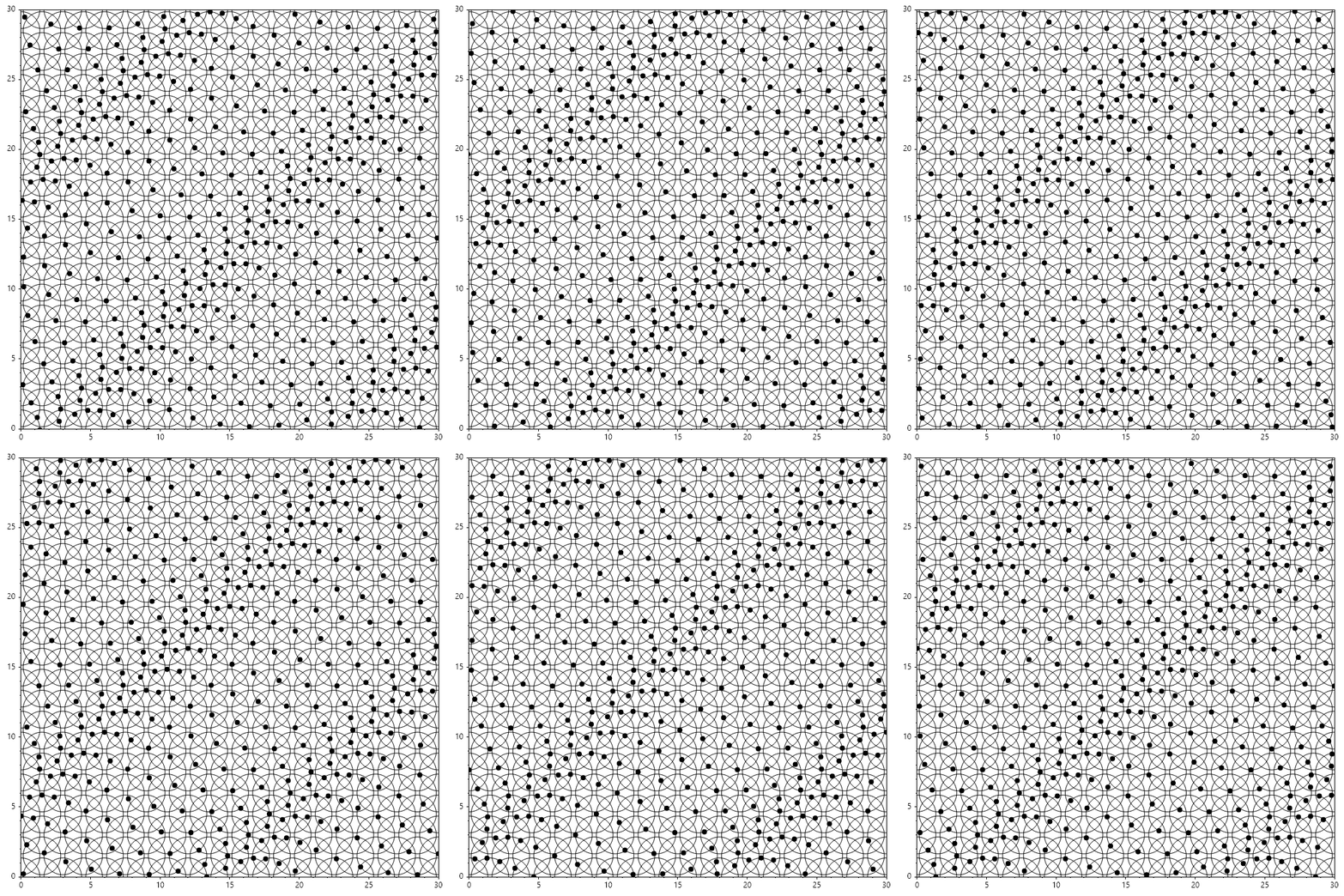
We can take advantage of this broadcasting to easily make animation as shown below
// 1 unit circle about origin
RowVec t = Linspace(0, 2*pi), c = Cos(t), s = Sin(t);

// mesh of centers
(Matrix x, Matrix y) = Meshgrid(Linspace(0, 30, 21));
ColVec X = x.ToArray(), Y = y.ToArray(), T = 0.1*pi*(X-Y);
double r = 1.35;

// Broadcasting circles of radius r
Matrix xm = X + r * c, ym = Y + r * s;
Figure(700, 700);
Plot(xm.T, ym.T, "k");

// Add scatter points to circles
HoldOn();
double[] scx = [], scy = [];
var sc = Scatter(scx, scy, "kof");
HoldOff();

// Bound axis [0,30];
Axis([0, 30, 0, 30]);

// animate scatter point movement around the circles.
double dt = 0.02*pi;
byte[] Animfun(int i)
{
    T -= dt;
    sc.Xdata = X + r*Cos(T);
    sc.Ydata = Y + r*Sin(T);
    return GetFrame();
}
AnimationMaker(Animfun, "Illusion.gif", 30, 100);
Transpose, Inverse, Determinant, Rref
Transpose
Definition: The transpose of a matrix is obtained by flipping it over its diagonal, turning rows into columns and columns into rows.
Column Vector: A column vector becomes a row vector when transposed.
Row Vector: A row vector becomes a column vector when transposed.
Matrix: Each element \(a_{ij}\) moves to position \(a_{ji}\).
// Matrix transpose
Matrix A = new double[,] { { 1, 2, 3 },
                           { 4, 5, 6 },
                           { 7, 8, 9 } };
Console.WriteLine($"A^T = \n{A.T}");
Ouput
A^T =

 1   4   7
 2   5   8
 3   6   9
Inverse
Definition: The inverse of a square matrix \(A\) is another matrix \(A^{-1}\) such that:
where \(I\) is the identity matrix. * Column/Row Vectors: Vectors are not square matrices, so they do not have inverses in the matrix sense. * Matrix: Only square matrices can have inverses. A matrix has an inverse if and only if its determinant is non-zero.
// Matrix inverse
Matrix A = new double[,] { { 1, 2, 3 },
                           { 4, 5, 6 },
                           { 7, 8, 9 } };
Console.WriteLine($"A^-1 = \n{A.Inverse()}");
Ouput
A^-1 =
1e16*
   0.3153   -0.6305    0.3153
  -0.6305    1.2610   -0.6305
   0.3153   -0.6305    0.3153
Determinant
Definition: A scalar value computed from a square matrix, representing scaling factor and orientation of linear transformation.
Column/Row Vectors: Not square, so determinant is not defined.
Matrix: For a \(2 \times 2\) matrix:
// 2x2 Matrix determinant
Matrix A = new double[,] { { 1, 2 },
                           { 3, 4 } };
double det = A.Det();
Console.WriteLine($"det(A) = {det}");
Ouput
det(A) = 2
// 3x3 Matrix determinant
Matrix A = new double[,] { { 1, 2, 3 },
                           { 4, 5, 6 },
                           { 7, 8, 9 } };
double det = A.Det();
Console.WriteLine($"det(A) = {det}");
Ouput
det(A) = -9.516197353929915E-16
For larger matrices, determinants are computed using expansion or row-reduction methods.
RREF (Reduced Row Echelon Form)
Definition: A matrix is in RREF if:
Each leading entry is 1.
Each leading 1 is the only non-zero entry in its column.
Leading 1s move to the right as you go down rows.
Column Vector: Reduces to a form where the first non-zero entry is 1, and all entries below are 0.
Row Vector: Reduces to a single row with leading 1 and zeros elsewhere.
Matrix: RREF is used to solve systems of linear equations.
// Matrix Rref
Matrix A = new double[,] { { 8,    1,    6,    1,  16 },
                           { 3,    5,    6,    1,  15 },
                           { 4,    7,    2,    1,  14 } };
(Matrix R, Indexer P, Matrix N) = A.Rref();
Console.WriteLine("\n A = \n" + A
                + "\n R = \n" + R
                + "\n P = \n" + P
                + "\n N = \n" + N);
Ouput
 A =

 8   1   6   1  16
 3   5   6   1  15
 4   7   2   1  14

 R =

   1.0000    0.0000    0.0000    0.0690    1.0690
   0.0000    1.0000    0.0000    0.0862    1.0862
   0.0000    0.0000    1.0000    0.0603    1.0603

 P =
0,   1,      2
 N =

  -0.0690   -1.0690
  -0.0862   -1.0862
  -0.0603   -1.0603
   1.0000    0.0000
   0.0000    1.0000
Rref in sepalsolver gives the rref, the row permutation indexer, and the null space basis matrix.